

What the future holds for cybersecurity in connected vehicles
Geolocation, driving habits, wear and tear, battery charge, infotainment, driver assistance feature – a modern car comprises more than 100 million lines of code1, significantly more than an airliner. These software-laden vehicles operate with hundreds of sensors designed to improve driving, comfort and energy efficiency and, more broadly, to contribute to road safety and infrastructure optimisation.
Far from their initial status as “simple” mechanical machines, today’s vehicles are nothing less than mobile computers. “Virtually all components of a modern vehicle produce data. Some data is exclusively related to the vehicle, such as engine temperature or revolutions per minute, while other data is related to the user,” explains Thomas Le Goff, senior lecturer in digital law and regulation at Télécom Paris (IP Paris).
This information inevitably creates new vulnerabilities in security terms, whether from the perspective of cyberattacks, cyber espionage or the protection of personal information. How can we reconcile the necessary sharing of data between users and mobility-related service providers (maintenance, driving assistance, entertainment, etc.) with the confidentiality of this data?
A complex legal landscape
In practice, in Europe, the sector is governed by a patchwork of regulations, including the General Data Protection Regulation (GDPR), the Cyber Resilience Act, and the very recent European Union Data Act. This set of standards overlaps with a comprehensive body of national and international sectoral rules, making the legal landscape particularly complex for the automotive industry.
Data generated by a vehicle, like that from other connected services or objects, must now be accessible to users and transferable to third parties of their choice
“We want to understand how the different texts fit together in order to eliminate redundancies, simplify the scope of application, clarify the responsibilities of each player, and limit the number of obligations to what is strictly necessary,” explains Thomas Le Goff, who conducts his work within the Research Chair on Intelligent Cybersecurity for Mobility Systems. “Our work can contribute to the simplification of legislation at the French and European levels,” he emphasises. Established by Télécom Paris (IP Paris) with six major industrial partners (Renault, Thalès, Solent, ZF Group, IRT SystemX and Boston Consulting Group), the Chair aims to help companies navigate this constantly evolving legal framework, in addition to developing new approaches to enhance the security of connected vehicles.
Increased data flow
In this rapidly evolving legal framework, the Data Act, which came into force in September 2025, increases the flow of data between users and businesses (B2C), between businesses (B2B) and between businesses and public authorities (B2G). The regulation “is designed to empower users, both consumers and businesses, by giving them greater control over the data generated by their connected products, such as cars or industrial machines. It lays the foundations for an open, competitive, fair and innovative European data economy,” according to the European Commission2.
In other words, data generated by a vehicle, like that from other connected services or objects, must now be accessible to users and transferable to third parties of their choice. “Typically, we could have a GPS or driver assistance system developed by a French company with data hosted in France, ensuring a high level of sovereignty, whereas currently it is inevitably the manufacturer who has control over all the data,” explains Thomas Le Goff.
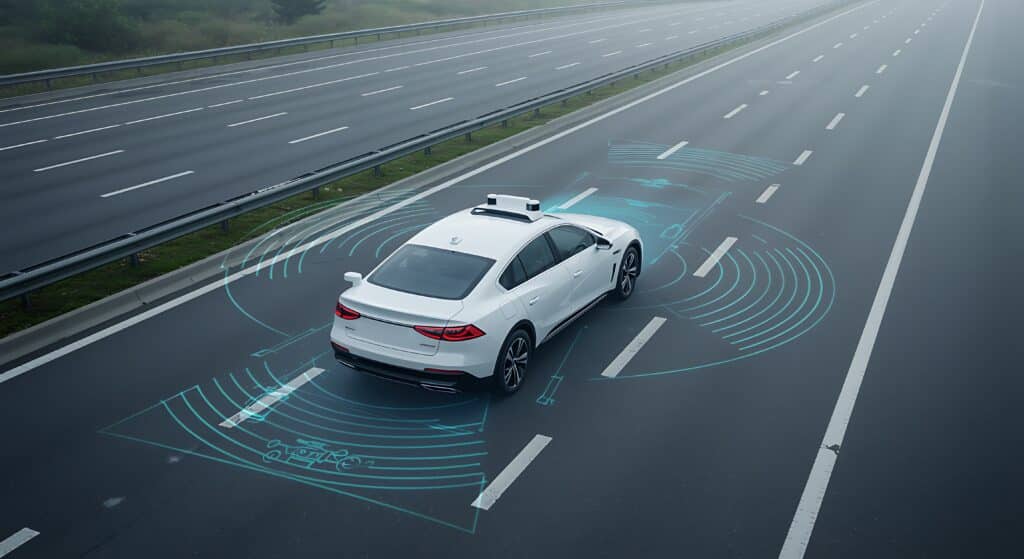
In doing so, however, the regulation creates tension between the drive for open data and security criteria, as companies must comply with these obligations while protecting privacy, trade secrets and proprietary technologies. “This tension is the subject of two theses within the Chair: one on the articulation of cybersecurity regulations in the automotive sector, and the other on technical measures to reconcile the dynamics of openness and data security,” says the lawyer.
This raises several questions. What degree of industrial secrecy do we want to protect? What encryption technology should be implemented to share this data securely? How can cybersecurity guarantees be integrated into all stages of the life cycle of a vehicle that can be on the road for around 15 years?
One thing is certain, “the purpose of the data regulation is not to impose constraints,” the expert points out. “The aim is to force players who have an economic incentive to keep information secret to release it so that other companies can create services.” The idea is to stimulate European competitiveness by “opening up” data from connected objects.
Data sovereignty
By opening up the flow of data in this way, the Data Act could potentially help to increase digital sovereignty by reducing strategic dependencies on non-European players.
It should be remembered that more than 70% of the data3 of European companies is stored on clouds that are mainly American and Chinese. “In cybersecurity legislation and new data regulations, provisions require companies to protect data from potential access by foreign powers,” says Thomas Le Goff.
Indeed, like the Cloud Act or FISA in the United States, several foreign jurisdictions allow access to data hosted by their companies, even if it is physically stored on European territory. “These extraterritorial laws further complicate the picture. The idea is to locate the data in Europe and put measures in place to prevent actors subject to foreign legislation, such as Amazon or Microsoft, from exfiltrating data…”
In this regard, the Data Act also removes the barriers that previously prevented easy migration to another provider. It requires cloud computing service providers to guarantee data portability, allowing companies to move their data freely and break free from proprietary systems and siloed infrastructures. “But there is no ideal solution,” warns Thomas Le Goff. “Total immunity from extraterritorial laws, such as the US FISA, is very difficult to guarantee in practice. All it takes is for a company to have operations in the territory of a third country to risk being required to share data with the authorities of that country, as confirmed by the recent decision in Canada concerning OVHCloud4, which is a French company. We can therefore only adopt a risk minimisation approach, without ever really being able to eliminate risk completely.”