

Pete Buttigieg says EVs are still the future for automotive industry

Pete Buttigieg sounds off on Ford worker suspended for heckling Trump
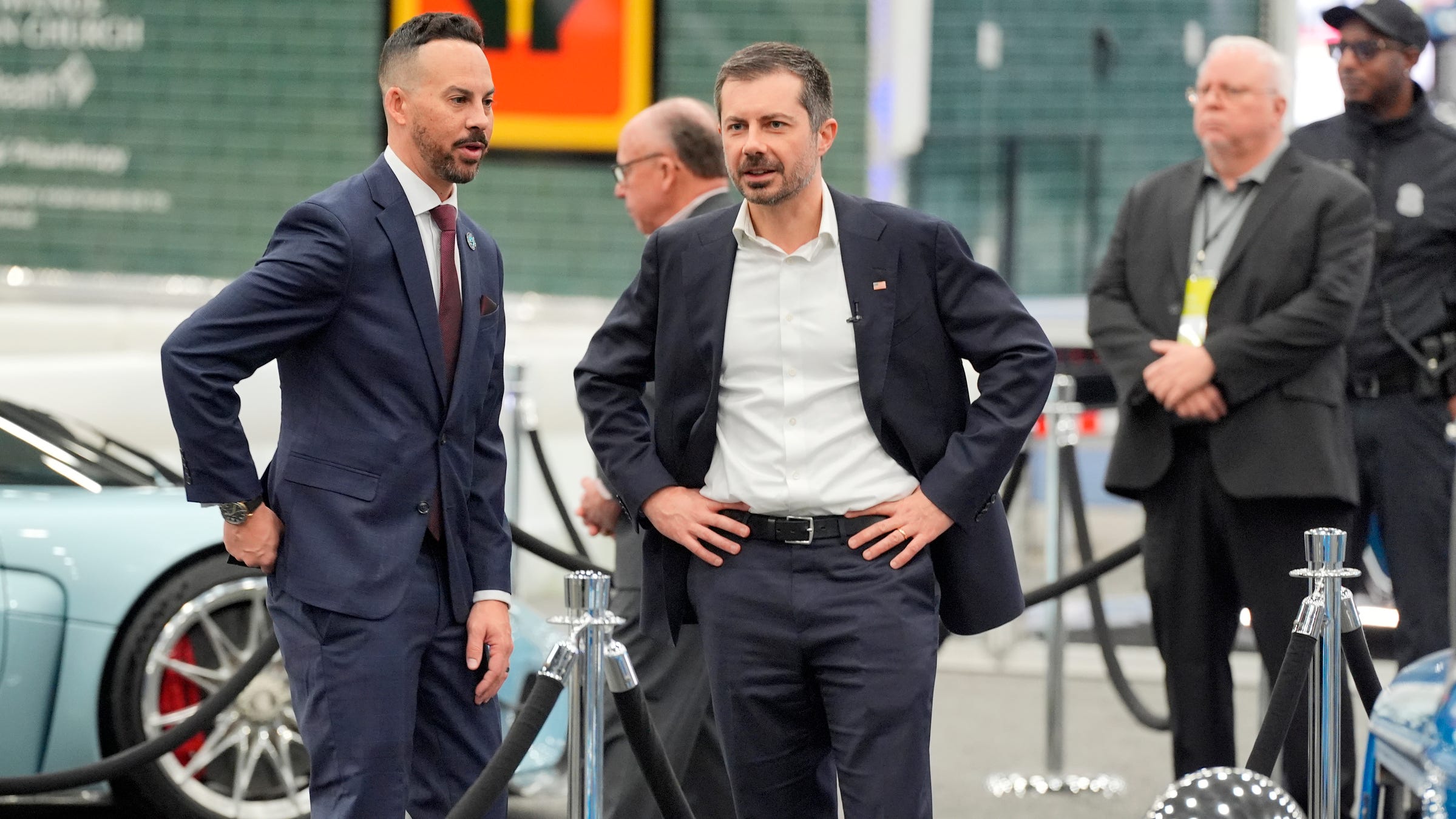
Former US Secretary of Transportation Pete Buttigieg says his sympathies are with the worker, not Trump, on Jan. 14, 2026, at the Detroit auto show.
- In a fireside chat with MSU President Kevin Guskiewicz at the Detroit Auto Show, Buttigieg spoke about EVs, China and Trump’s tariff policies.
- Electrification, Buttigieg said, should still be prioritized despite deregulation from the Trump administration that may encourage automakers to make more gas-powered cars.
- Buttigieg also addressed the suspension of a Ford employee who heckled U.S. President Donald Trump.
Former U.S. Secretary of Transportation Pete Buttigieg visited the Detroit Auto Show to discuss the future of electric vehicles in the U.S., Chinese competition, tariffs and the suspension of a UAW-represented Ford Motor Co. employee for shouting at U.S. President Donald Trump.
Buttigieg, who lives in Traverse City in northern Michigan, served as the secretary of transportation from 2021 to 2025 under then-President Joe Biden, a role in which Buttigieg said he saw the “bleeding edge of U.S. innovation.” Buttigieg oversaw transportation in the country during the 2021 semiconductor chip shortage and the federal government’s incentives to emphasize production and sale of electric vehicles — a move that Trump has since undone.
In a fireside chat with Kevin Guskiewicz, the president of Michigan State University, Buttigieg touched on an array of topics about the automotive industry, saying the U.S. must continue to develop and improve electric vehicles despite the Trump administration’s de-emphasis on the industry.
On electrification and China
Buttigieg said he still believes EVs are the future of American mobility, though he’s not sure how long it will take — or whether American automakers will lead the way.
“Leadership of the automotive sector by right ought to be on American soil,” Buttigieg said, noting that the federal government’s deregulation and automakers’ recent pivots away from electrification may hurt the U.S.’s ability to compete with China, which is both the world’s leading exporter of vehicles by volume and electric vehicles.
Since taking office, Trump has proposed significant slashes to fuel emissions regulations and cut a federal program that offered a $7,500 incentive to buyers of electric vehicles. Both policy changes, experts say, stand to slash the profitability of EVs and curb electrification industry-wide in the U.S.
“There is no question about whether this technology will be the future of the sector. There is a big question about whether the U.S. will lead that,” Buttigieg said, calling the current era of electrification versus gas-powered vehicles “the most transformational moment” for the automotive industry since the invention of the internal combustion engine.
On Tariffs
One of the tools the federal government is using to keep Chinese vehicles out of the U.S. is the tariff, which Buttigieg said has “failed to deliver an increase in manufacturing employment in this country this year.”
Buttigieg said he could see a version of U.S. trade policy that uses tariffs carefully to boost production in the country, but criticized the Trump administration’s broad and aggressive tariff stance.
“In that sense, the tariff policy has objectively been a failure,” Buttigieg said. “The purpose of the tariff policy in the particular way it was implemented was mostly to concentrate power in the hands of the White House.”
Since Trump enacted the tariffs, the Detroit Three automakers reacted with large investments and commitments to shift production back to the U.S., while also posting large losses as they de-electrify their lineups. Stellantis invested $13 billion into its midwestern manufacturing footprint. Ford said it will record $19.5 billion in charges as it pivots to a portfolio with fewer EVs and more gas-powered vehicles. General Motors, too, said it lost about $7.6 billion shifting away from EVs in 2025.
Buttigieg said automakers that have flocked to support Trump as he rolls out sweeping import tariffs on vehicles made outside of the U.S. may be doing so in order to preserve their companies.
“It turns out the best thing you can do for your company, your industry or your country is to get on (Trump’s) good side,” Buttigieg said.
Buttigieg also addressed the suspension of a UAW-represented Ford employee who had a testy interaction with Trump on Jan. 13 while he toured one of the automaker’s plants in Dearborn. The now-suspended employee, Buttigieg said, should be reinstated.
“I don’t know much about the HR side of it, what I know is President Trump did literally what he has been doing figuratively, which is give autoworkers the finger,” Buttigieg said when the Detroit Free Press asked him about the incident.
Liam Rappleye is an automotive reporter for the Detroit Free Press. Contact him: LRappleye@freepress.com.