

New Whiplash Test Shows Safety Gaps
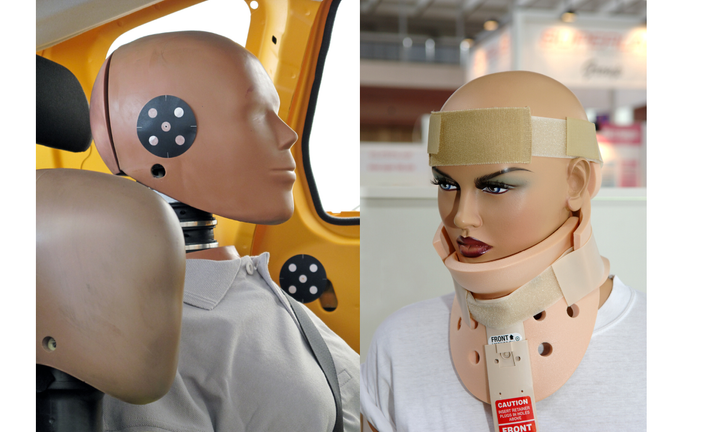
The new test measures pelvic displacement and the tilting or bending force of the head relative to the neck, either forward or backward.
In an effort to reduce whiplash-related injuries, the Insurance Institute for Highway Safety launched a new test to evaluate seat and head restraints and their prevention of neck injuries stemming from rear-end crashes. Of the 18 small SUVs tested, only four earned good ratings.
“Neck sprains and strains are the most frequently reported injuries in U.S. auto insurance claims,” IIHS President David Harkey said. “This new test challenges automakers to further improve their seats and head restraints to provide better protection in the rear impacts that typically cause these injuries.”
The original head restraint test used a single pulse equivalent to being struck at 20 mph by a vehicle of the same weight. But the test was discontinued in 2022 due to improved auto designs that made almost all vehicles earn good ratings. Despite the improvements, though, occupants of good-rated vehicles were still sustaining whiplash injuries, according to IIHS.
After research and analysis, the organization added several metrics to the testing. The new version uses separate acceleration pulses to simulate crashes at 20 mph and 30 mph. The metrics include pelvic displacement (preventing the pelvis from moving forward relative to the head) and the tilting or bending force of the head relative to the neck, either forward or backward. The old and new measures are combined to gauge head and spine support, the interaction of the head with the head restraint, and how well the seat manages the transfer of energy to the occupant’s body.
“We don’t yet fully understand the mechanisms that cause whiplash injuries,” said Marcy Edwards, the IIHS senior research engineer who developed the new evaluation. “But our research makes us confident that reducing these types of movements and stresses should cut down on whiplash injuries in the real world.”
The four small SUVs with good ratings are the Audi Q3, Hyundai Ioniq 5, Subaru Forester and Toyota RAV4.
Those rated acceptable are the Buick Encore GX, Chevrolet Equinox, Honda CR-V, Jeep Compass, Kia Sportage, Mercedes-Benz GLB-Class, Mitsubishi Outlander, Volkswagen Taos and Volvo XC40.
The marginal performers were the BMW X1 and Nissan Rogue.
And the poorest performing vehicles were the Ford Bronco Sport, Hyundai Tucson and Mazda CX-50.