

Europe Electric Vehicle Market Accelerates Toward a $422 Billion Future by 2033
Europe is racing ahead in the global transition toward clean transportation, and electric vehicles (EVs) are at the center of this transformation. With ambitious climate policies, rising environmental awareness, and rapid technological innovation, the continent is witnessing a powerful shift away from internal combustion engines toward electric mobility.
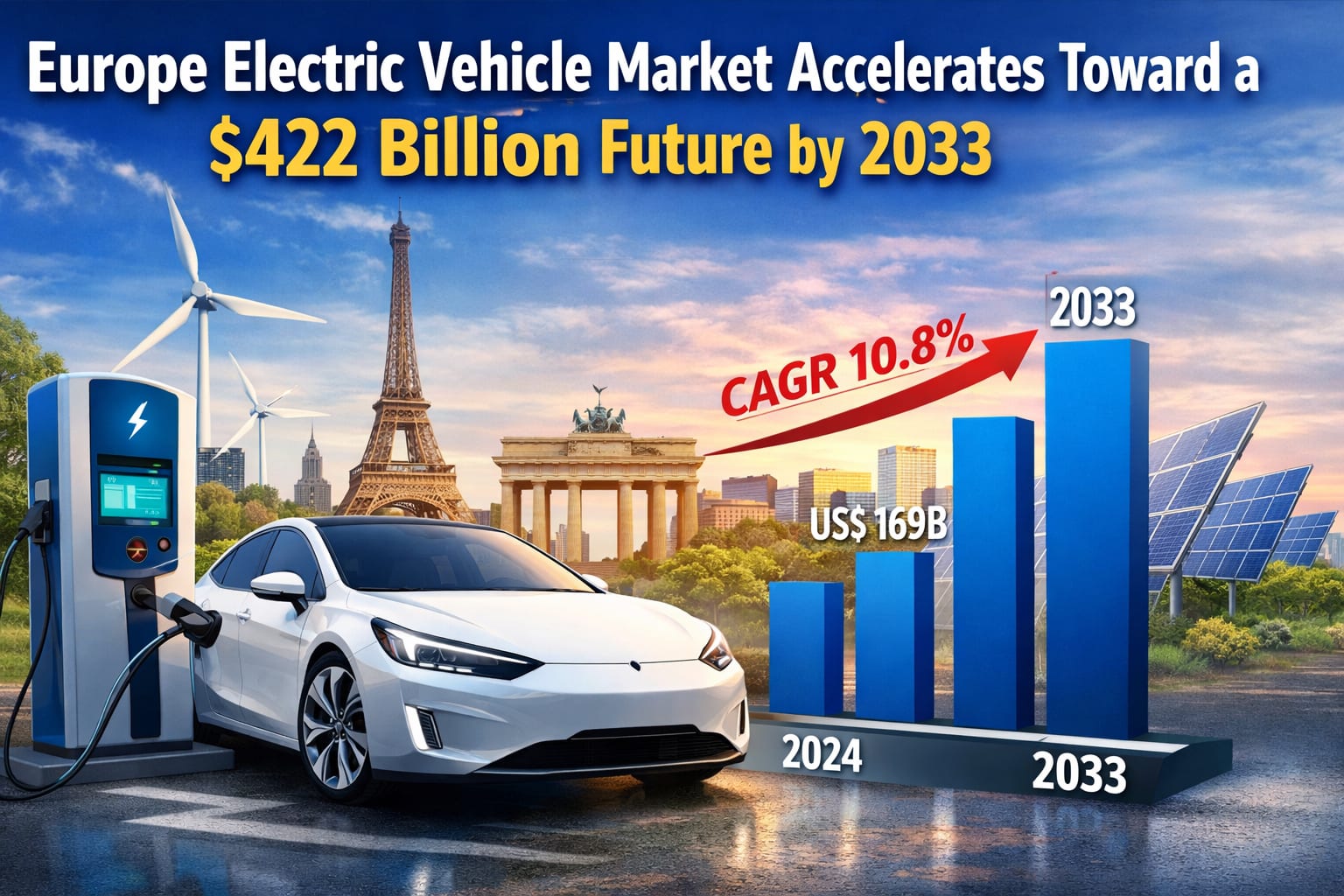
According to recent market insights, the Europe Electric Vehicle Market is projected to grow from US$ 169 billion in 2024 to US$ 422.27 billion by 2033, expanding at a compound annual growth rate (CAGR) of 10.80% from 2025 to 2033.
This remarkable growth story is not just about numbers—it reflects a deeper structural change in how Europe powers its mobility, reshapes urban environments, and tackles climate change.
The Evolution of Electric Mobility in Europe
Electric vehicles are no longer a niche innovation—they are rapidly becoming mainstream. Unlike traditional vehicles powered by fossil fuels, EVs rely on electric motors driven by rechargeable batteries. This fundamental shift significantly reduces greenhouse gas emissions and urban air pollution.
Over the past decade, improvements in EV technology have enhanced performance, extended driving range, and reduced costs. At the same time, governments and private players have collaborated to build a more robust charging ecosystem, making EV ownership increasingly practical.
Urbanization has also played a major role. As European cities grapple with congestion and pollution, electric mobility offers a cleaner, quieter alternative. Consumers are becoming more conscious of their environmental footprint, and EVs are emerging as a preferred choice for sustainable living.
Strong Policy Framework Driving Adoption
One of the most powerful catalysts behind Europe’s EV boom is its regulatory environment. The European Union has taken aggressive steps to combat climate change, including the “Fit for 55” package aimed at reducing emissions by 55% by 2030.
Even more transformative is the plan to ban the sale of new internal combustion engine vehicles by 2035. This policy alone has forced automakers to rethink their long-term strategies and invest heavily in electrification.
Governments across Europe are further supporting EV adoption through:
Purchase subsidies
Tax incentives
Reduced registration fees
Access to low-emission zones
These measures lower the financial barrier for consumers while creating strong demand across multiple vehicle segments. As a result, automakers are accelerating production and launching new EV models at an unprecedented pace.
Battery Technology: The Game Changer
Battery innovation lies at the heart of the EV revolution. Historically, high battery costs were a major barrier to adoption. However, advancements in lithium-ion technology and emerging solid-state batteries are transforming the landscape.
Modern batteries offer:
Higher energy density
Faster charging times
Longer driving ranges
Improved safety
These improvements are directly addressing consumer concerns such as “range anxiety” and charging convenience. As battery costs continue to decline, EVs are becoming increasingly competitive with traditional vehicles.
European manufacturers and research institutions are heavily investing in battery R&D, often collaborating with global partners. This not only strengthens Europe’s position in the EV ecosystem but also aligns with its broader goal of leading sustainable innovation.
Charging Infrastructure Expansion
A key enabler of EV adoption is the availability of reliable charging infrastructure. Europe has made significant progress in this area, with approximately 700,000 public charging points installed by the end of 2023, marking a 35% increase year-over-year.
Initiatives such as ultra-fast charging networks are further enhancing convenience. For example, projects like “Electrify France” aim to deploy high-speed charging stations across strategic locations, including highways and urban centers.
Additionally, collaborative platforms are integrating thousands of charging points across multiple countries, enabling seamless cross-border travel for EV users.
This rapid infrastructure expansion is crucial in reducing range anxiety and making EV ownership more practical for everyday use.
Changing Consumer Attitudes
The shift toward EVs is not driven by policy alone—consumer behavior is evolving as well. Increasing awareness of climate change, air pollution, and sustainability has influenced purchasing decisions.
Modern consumers are:
Prioritizing eco-friendly products
Seeking long-term cost savings
Embracing technological innovation
Ride-hailing and car-sharing services have also played a role in familiarizing people with EVs. As more fleets transition to electric vehicles, users gain firsthand experience of their benefits, accelerating broader adoption.
Market Segmentation Insights
The Europe Electric Vehicle Market is highly diversified, spanning multiple segments:
By Product:
Battery Electric Vehicles (BEVs)
Hybrid Electric Vehicles (HEVs)
Plug-in Hybrid Electric Vehicles (PHEVs)
By Range:
Up to 150 miles
151–300 miles
Above 300 miles
By Vehicle Type:
Two-wheelers
Passenger cars
Commercial vehicles
By Vehicle Class:
Low-priced
Mid-priced
Luxury
Passenger cars currently dominate the market, but commercial EVs are gaining traction as logistics companies aim to reduce emissions and operating costs.
Country-Level Insights
Germany: A Manufacturing Powerhouse
Germany stands as one of Europe’s most influential EV markets. Backed by strong government incentives and world-renowned automakers, the country is leading the transition to electric mobility.
Major automotive companies are investing heavily in EV production, while policies such as subsidies and tax benefits encourage consumer adoption.
However, challenges remain, including high vehicle costs and dependence on imported raw materials for battery production. Despite this, Germany remains committed to expanding its EV fleet significantly by 2030.
France: Rapid Adoption and Infrastructure Growth
France has emerged as a fast-growing EV market, with electric vehicles accounting for 26% of new car sales in 2023.
Government incentives and the availability of affordable models are key drivers. The country is also investing heavily in charging infrastructure and aims to produce over one million EVs by 2027.
This combination of policy support and industrial ambition positions France as a critical player in Europe’s EV future.
United Kingdom: Ambitious Targets
The United Kingdom is another major market, driven by ambitious government targets. The country aims for:
80% of new car sales to be zero-emission by 2030
100% by 2035
While adoption is growing, challenges such as high electricity costs and consumer skepticism remain. To address these issues, the government is introducing supportive measures like subsidized loans.
Challenges Hindering Growth
Despite strong momentum, the Europe EV market faces several hurdles:
1. High Upfront Costs
Even though long-term ownership costs are lower, EVs still have higher initial prices compared to traditional vehicles. This limits adoption among price-sensitive consumers, particularly in regions with fewer subsidies.
2. Supply Chain Constraints
Europe relies heavily on imports for critical raw materials such as lithium, cobalt, and nickel. Geopolitical tensions and rising global demand create supply risks and price volatility.
These challenges can delay production, increase costs, and slow down market expansion if not addressed effectively.
Competitive Landscape
The European EV market is highly competitive, featuring both established automakers and emerging players. Key companies include:
Tesla, Inc.
BMW Group
BYD Company Ltd.
Mercedes-Benz Group AG
Ford Motor Company
Nissan Motor Co. Ltd
Toyota Motor Corporation
Audi AG
These companies are focusing on innovation, expanding product portfolios, and forming strategic partnerships to strengthen their market position.
The Road Ahead
The future of Europe’s electric vehicle market looks exceptionally promising. As policies become stricter, technologies improve, and infrastructure expands, EV adoption is expected to accelerate further.
Key trends to watch include:
Growth of ultra-fast charging networks
Advancements in solid-state batteries
Increased localization of battery production
Expansion of EVs in commercial fleets
The transition to electric mobility is not just an industry shift—it is a societal transformation that will redefine transportation, energy consumption, and urban living across Europe.
Final Thoughts
Europe’s electric vehicle market is at a pivotal moment. With strong regulatory backing, technological innovation, and growing consumer acceptance, the region is well on its way to becoming a global leader in sustainable mobility.
While challenges such as high costs and supply chain dependencies remain, ongoing investments and policy support are expected to address these barriers over time.