
MRAM Emerges as Game Changer for AI and Future Vehicles with 1000x Speed, Low Power

Samsung Electronics (005930.KS) is focusing on magnetoresistive random-access memory (MRAM) development as the technology emerges as a game changer capable of overcoming the power consumption and heat limitations of current mainstream memory chips such as DRAM and NAND flash. Samsung Electronics and Taiwan’s TSMC are racing to advance their technologies as they compete for dominance in the growing market centered on automotive memory for electric vehicles and autonomous cars. As MRAM development competition heats up, domestic and international rivalry is also intensifying across the broader field of spintronics, a core underlying technology.
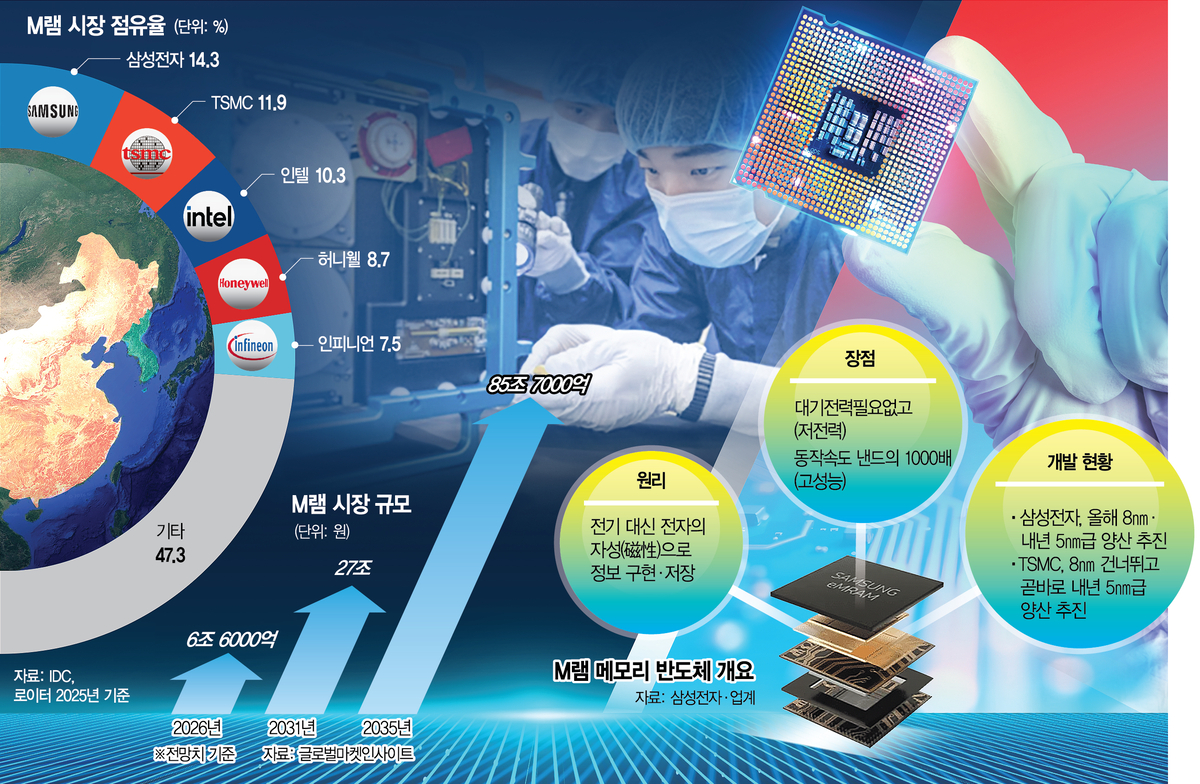
According to industry sources on January 16, Samsung Electronics’ foundry division is developing technology aimed at mass-producing 5nm process-based MRAM next year with enhanced performance, following this year’s 8nm milestone. TSMC also began developing 5nm MRAM last year and has set the same 2027 timeline for mass production readiness as Samsung. Notably, after completing 12nm MRAM verification last year, TSMC is pursuing a leap-ahead strategy by skipping 8nm and focusing directly on 5nm MRAM. This has sparked full-scale leading-edge process competition between the two major foundries in the MRAM sector, following their rivalry in conventional memory.
Both companies are expanding the MRAM ecosystem while focusing on capturing the automotive memory market first. Samsung recently emphasized at the International Solid-State Circuits Conference (ISSCC) 2026 that its 8nm MRAM meets the high-reliability “Auto-G1” grade of the AEC-Q100 automotive semiconductor durability standard, demonstrating full performance under harsh conditions including temperature fluctuations from minus 40 to 150 degrees Celsius and low voltage of 0.6V. The company also plans to supply 5nm MRAM primarily for automotive applications. TSMC has partnered with Dutch semiconductor company NXP to introduce automotive microcontroller (MCU) products equipped with 16nm MRAM.
According to market research firm Global Market Insights, Samsung Electronics and TSMC led early competition last year with market shares of 14.3% and 11.9% respectively, ranking first and second. The top five companies including Intel, Honeywell, and Infineon together held a majority 52.7% share.