

What does the future hold for Mexico’s Chinese EV boom?
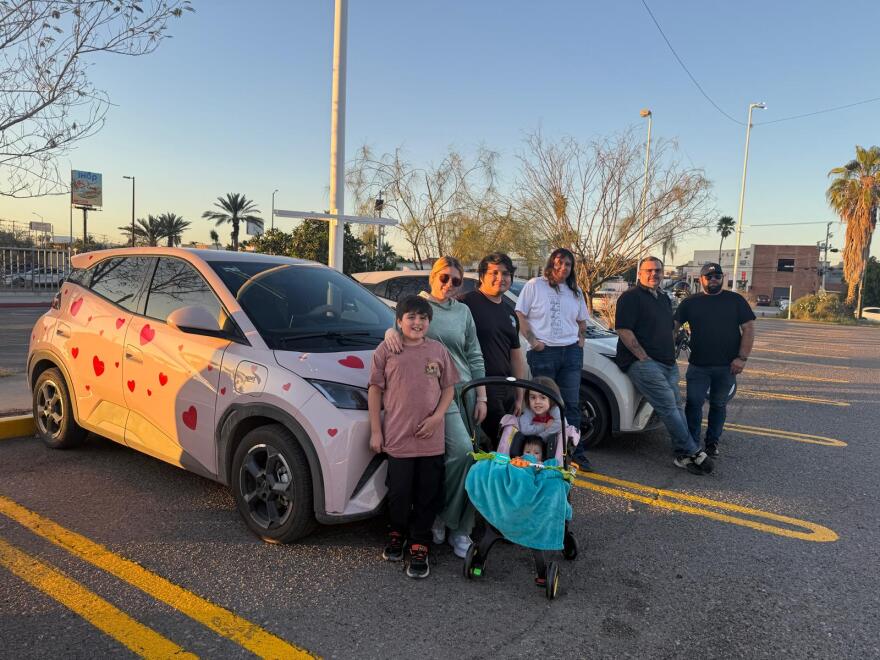
A tattooed rideshare driver in Hermosillo, Sonora, smoked a cigarette as he leaned against the hood of his beige, pint-sized electric car.
“The savings are big,” said Juan Navarro, who used to spend about $25 a day on gas before buying his BYD Dolphin Mini. He spends a fraction of that to charge the Chinese electric car.
Just three hours north, on the other side of the U.S.-Mexico border, consumers won’t find the car that changed Navarro’s livelihood at their local dealership — or almost anywhere else. As the United States maintains extremely high tariffs on Chinese cars, and even bans some of their technology, it’s also peering over the border to assess how to respond to the proliferation of cars like Navarro’s in Mexico.
Nina Kravinsky
/
KJZZ
It’s an issue that will play a role in ongoing trade talks between the United States, Mexico and Canada. How they move forward could dictate the future of Mexico’s electric vehicle landscape.
Navarro is one of dozens of members of a meetup group of other Dolphin Mini owners. Like him, most of them also bought the cars to drive around Hermosillo for apps like Uber.
On a recent weekday evening, a few gathered at dusk in a parking lot, including Fabián Morales. Just two years ago, he became one of the first owners of the fully electric hatchbacks in Hermosillo.
“It’s growing really quickly,” Morales said.
In just a few years, Chinese electric vehicles have become a fixture on Mexican streets — like they have in countries across the globe — even as they’re virtually banned in the United States.
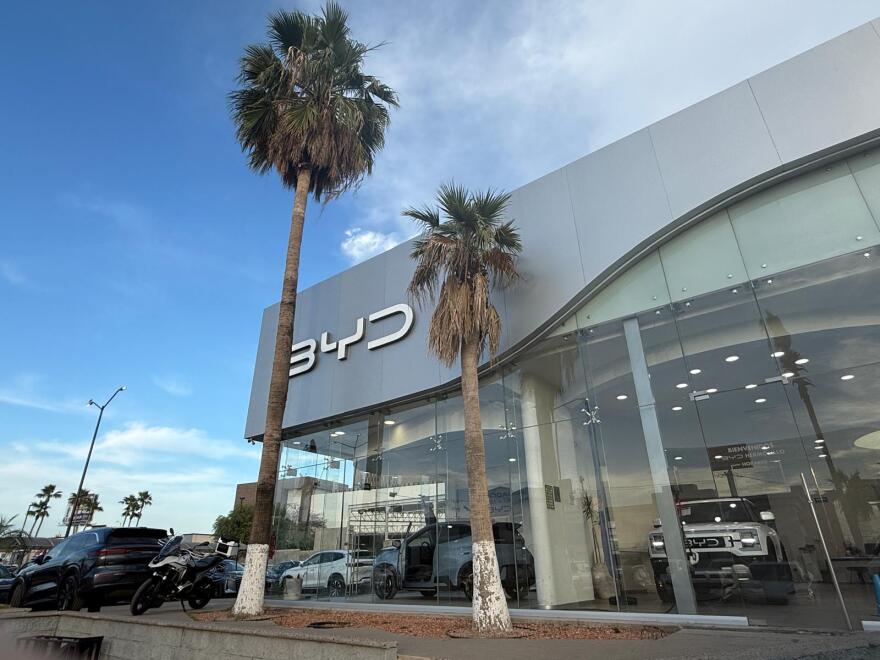
In Hermosillo, a sleek, modern BYD dealership sells electric pickup trucks, SUVs and sedans at a lower price point than most of its electric vehicle competitors. Chinese car companies have dominated electric vehicle sales in many countries after seeing success domestically, said Ilaria Mazzocco with the Center for Strategic and International Studies.
“Chinese automakers have been really eager to find new markets,” Mazzocco said.
Chinese companies like BYD have been able to keep their prices low partially because of government subsidies but also because they are able to produce batteries and other components in house, Mazzocco said.
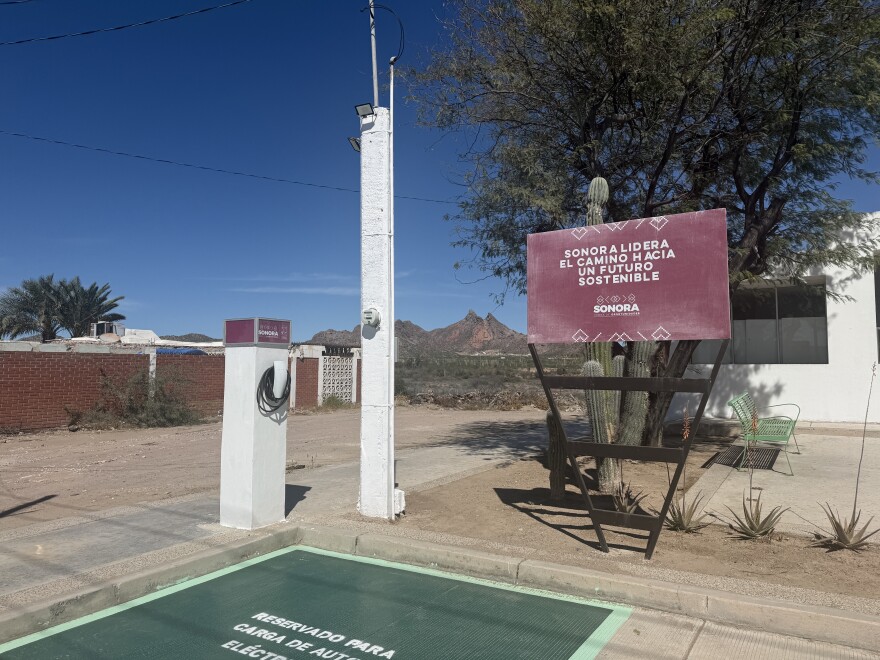
Over the past six or so years, those imported Chinese cars have been a big driver of Mexico’s expanding electric vehicle infrastructure, Mazzocco said. The state of Sonora last year built its first public electric charging station to much fanfare in Hermosillo, the state capital. The city is also building out solar-powered charging ports.
Nina Kravinsky
/
KJZZ
As Chinese electric vehicles become more and more popular on the streets of countries like Mexico, car manufacturers from elsewhere have been unable — or unwilling — to keep up, Mazzocco said.
“The U.S. is certainly not offering an alternative here,” Mazzocco said.
But the United States has taken an interest in the rise of Chinese cars in Mexico. Officials fear Chinese investment in Mexico — and the rest of Latin America — has gotten too big. And in the United States, officials have banned cars with “connected” Chinese technology, citing national security concerns. Many Chinese vehicles carry software that has the potential ability to transmit data about the driver and their surroundings.
Those points are likely to come up in the upcoming review of the USMCA trade agreement that binds the United States, Mexico and Canada, Mazzocco said.
“Mexico has a really important relationship with the United States, and the U.S. has a really conflictual relationship with Chinese electric vehicles,” Mazzocco said. “That puts Mexico in a really awkward position.”
As it faces U.S. pressure to reduce its economic relationship with China, Mexico did put a hefty tariff on Chinese cars starting at the beginning of this year.
But the new tariff does more than just appease the United States, said Jorge Guajardo, a former Mexican ambassador to China. It also helps Mexico’s manufacturing sector.
“The auto sector is one of Mexico’s largest employers,” Guajardo said. “Both the auto manufacturing as well as auto parts manufacturing, and none of these Chinese cars have Mexican-made auto parts. So I think we’re putting a huge industry at risk by just letting them in.”
Nina Kravinsky
/
KJZZ
The 50% tariffs Mexico put on Chinese cars — and other cars from Asian countries that lack a free trade agreement with Mexico — is a “good first step,” Guajardo said. But Chinese companies are pricing their vehicles so low that more tariffs will likely be needed, he added.
“It is basically impossible to compete with the Chinese on price, so it puts everyone else at a disadvantage,” Guajardo said.
Back at the Dolphin Mini meetup, tariffs don’t seem to be weighing too heavily on anyone’s mind. Fernando Vargas has had his small electric car for just a week. Like the others in the group, he uses it to drive for rideshare apps.
Vargas estimates he’s making twice as much as he did with his gas car. A charge costs less than a full tank of gas and lasts for a few full days of work.
At that rate, and as the price of gas rises globally, he and the others seem unphased by the possibility of BYD replacement parts getting more expensive because of Mexico’s new tariff.
There’s agreement, too, that China is meeting a need that the United States seems to be failing to.
“I feel like they’re more advanced than the United States,” said group member Navarro.
So far, the group’s biggest enemy hasn’t been tariffs. It’s been the roads themselves, said Morales, who bought one of the first BYD Dolphin Minis in the city.
“”They’re really cool and all, but they’re not made for the streets of Hermosillo,” Morales said with a laugh. “The potholes are destroying my tires.”