

Funding Awarded to Support UK Autonomous Vehicle Deployments
Eight feasibility studies examining the use of autonomous vehicles in UK transport and logistics have received funding through a government-backed initiative designed to support the development of connected and automated mobility (CAM) technologies.
The funding has been awarded under the second round of the Feasibility Studies competition, part of the 150 million GBP CAM Pathfinder programme. The programme forms part of the Government’s Advanced Manufacturing Sector Plan and aims to support the transition of CAM technologies from development to commercial application.
The initiative is being delivered by the Department for Business and Trade in partnership with Innovate UK and Zenzic.

Buses developed by UK manufacturer, Wrightbus
© Creo Comms
The selected projects will explore potential business cases for autonomous vehicle deployment in sectors including aviation, freight, healthcare and urban transport. The studies are intended to address barriers to investment by assessing operational, regulatory and commercial requirements in both public and private settings.
Claire Spooner, Director of Innovation Service at Innovate UK said:
This latest tranche of funding from the CAM Pathfinder programme will enable the UK to unlock the huge future benefits of these new CAM technologies. These projects, around the UK, will develop new solutions for a range of CAM applications and scenarios and they will enable the companies behind these innovations to scale and grow.
Among the funded projects is ASPIRE, which focuses on the use of automated transport to respond to driver shortages and rising operating costs in public transport. The study is being carried out by Bamford Bus Company in collaboration with Loughborough University and Queen’s University Belfast.
A separate project led by Fusion Processing will examine how autonomous vehicles could be used to transport staff within airports. The study will assess staffing requirements, operational processes and potential cost savings.
In London, Odysse Limited will conduct a feasibility study into the use of Level 4 automated vehicles for private-hire services along high-demand routes. The project will consider the technical and regulatory conditions required for such services to operate.
In the North East of England, several projects will focus on freight and logistics. One study will assess the use of autonomous electric heavy goods vehicles between the Nissan manufacturing plant in Sunderland and the Port of Tyne. Another, known as TACTIC, will examine the feasibility of a driverless freight corridor linking Teesport and Teesside International Airport within the Teesside Freeport.
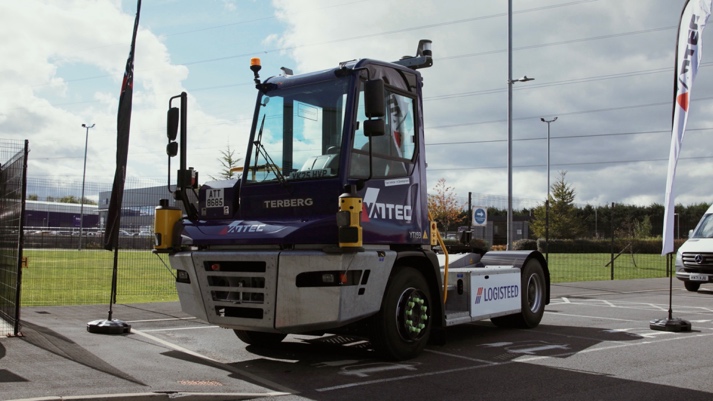
The autonomous V-CAL truck which has been in operation in the North East of England
© Creo Comms
Additional projects include a study into driverless shuttle services within NHS hospital sites, led by Moonbility Limited, and an assessment of autonomous yard tractors operating on a logistics route in Sunderland. A further study will explore the development of a dedicated autonomous vehicle corridor connecting the Wellcome Genome Campus to Whittlesford Parkway railway station in Cambridgeshire.
According to programme representatives, the studies are expected to contribute to the development of investment-ready business cases and support decisions on wider deployment of CAM technologies.
The CAM Pathfinder programme is intended to support the growth of the UK’s connected and automated mobility industry, which has been valued at 3.7 billion GBP.